Google Postmaster Tools: Plain-Language Verdicts

Postmaster Tools has always shown you spam-rate graphs and reputation bars and left you to decide what they meant. Across the domains we monitor, a newer layer has started showing up underneath those charts: Google Postmaster Tools verdicts, plain-English sentences telling you, directly, whether Gmail thinks your recipients want your mail.
We went through the Compliance Status and Deliverability Analysis dashboards on several domains we manage, cross-referenced what we saw against Google’s own Postmaster Tools API documentation, and worked out what these Google Postmaster Tools verdicts actually mean. The pattern that matters most: technical compliance and recipient sentiment are graded separately now, and they don’t always agree.
📊 Two Dashboards, Two Different Questions
Compliance Status asks “is it configured correctly.” Deliverability Analysis asks “do people want it.”
Compliance Status is a checklist. It looks like a handful of rows, but there’s more going on underneath than the dashboard lets on – more on that shortly.
Deliverability Analysis is a verdict. Instead of a bounce-rate chart you have to interpret yourself, it now states outright whether Gmail users appear to want your messages, and gives a recommended action underneath. Verdicts are computed per registrable domain and, where there’s enough data, per subdomain too.
✅ Compliance Status: What Passes and What Doesn’t
The dashboard reads as roughly eight rows, but it’s actually eleven distinct pass/fail checks underneath – a few of them (SPF, DKIM, and their combined check; DMARC’s policy and its alignment) get grouped together in the UI even though Google tracks and reports them separately. Here’s the full breakdown:
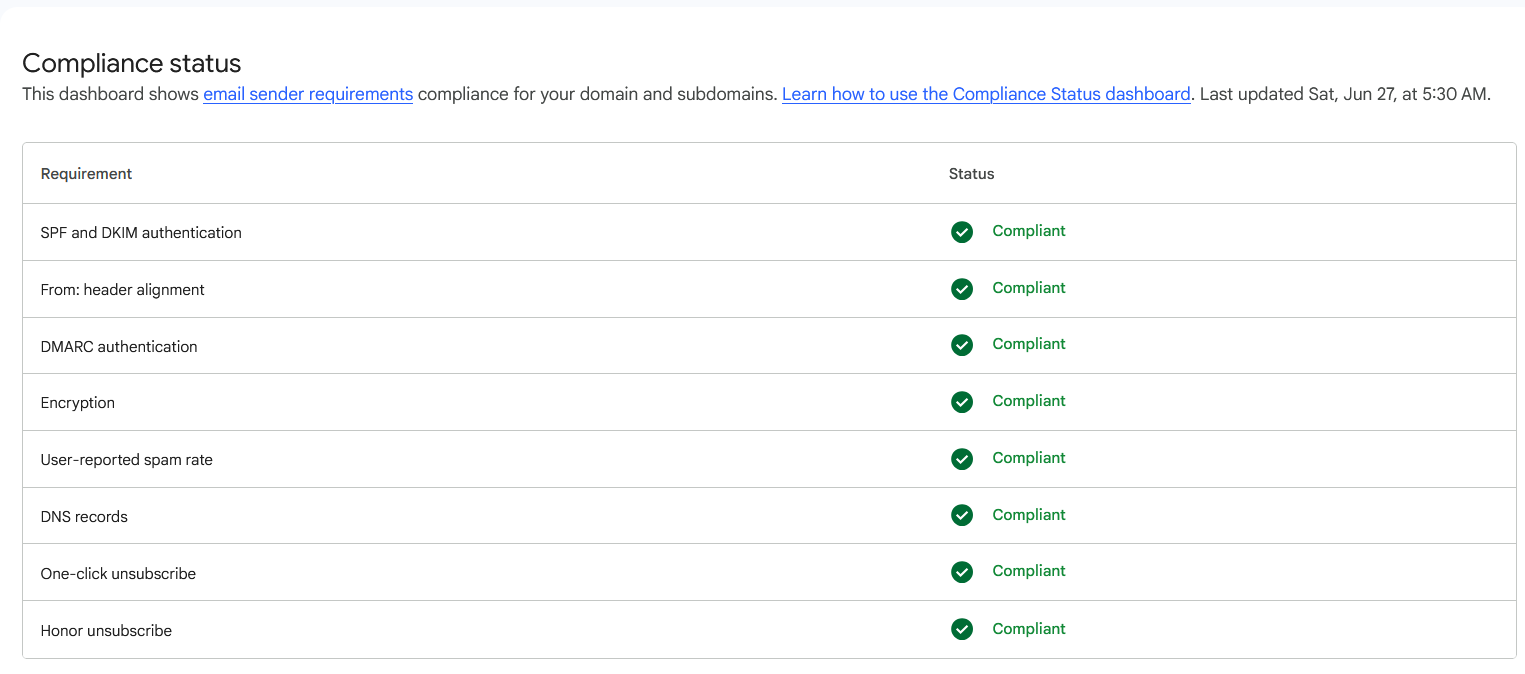
The Compliance Status dashboard as it appears in Postmaster Tools.
| Requirement (API enum) | What It Checks |
|---|---|
| SPF | Sender Policy Framework is configured correctly |
| DKIM | DomainKeys Identified Mail signing is configured correctly |
| SPF and DKIM | Both of the above pass together – tracked as its own combined check |
| DMARC policy | A DMARC policy is published for the domain |
| DMARC alignment | The visible From: header aligns with the SPF or DKIM domain – a separate pass/fail from the policy existing at all |
| Message formatting | Messages conform to RFC 5322 formatting rules |
| DNS records | The domain has both forward and reverse DNS records in place |
| Encryption | Messages are sent with TLS encryption |
| User-reported spam rate | Reported spam stays under Gmail’s threshold |
| One-click unsubscribe | Sufficiently supports one-click unsubscribe – Google notes this single user-facing label actually rolls up several underlying unsubscribe-support rules, not just the presence of a header |
| Honor unsubscribe | Unsubscribe requests are actually honored once received, not just offered |
Source: Google’s Postmaster Tools API reference, ComplianceRequirement enum (domains.getComplianceStatus, v2beta, Developer Preview) – view on developers.google.com.
A few of these eleven checks are worth a closer look. Three – one-click unsubscribe, From: header alignment, and DMARC authentication – are failures we actually saw on client domains, each flagged individually with a “Needs work” status while everything else stayed green. Honor unsubscribe is covered too, since it shares the same unsubscribe-compliance family and has its own documented sub-reasons worth knowing.
One-click unsubscribe
Flagged when bulk mail doesn’t carry a correctly implemented List-Unsubscribe header. This one has gotten stricter to enforce since Gmail and Yahoo’s 2024 bulk-sender requirements, and it’s an easy one to fail silently if a sending platform’s unsubscribe header isn’t configured the way Gmail expects.
| Spec reason | Google’s Definition |
|---|---|
| NO_UNSUB_GENERAL | Sender does not support one-click unsubscribe for the majority of their messages. |
| NO_UNSUB_SPAM_REPORTS | Sender does not support one-click unsubscribe for most messages that are manually reported as spam. |
| NO_UNSUB_PROMO_SPAM_REPORTS | Sender does not support one-click unsubscribe for most promotional messages that are manually reported as spam. |
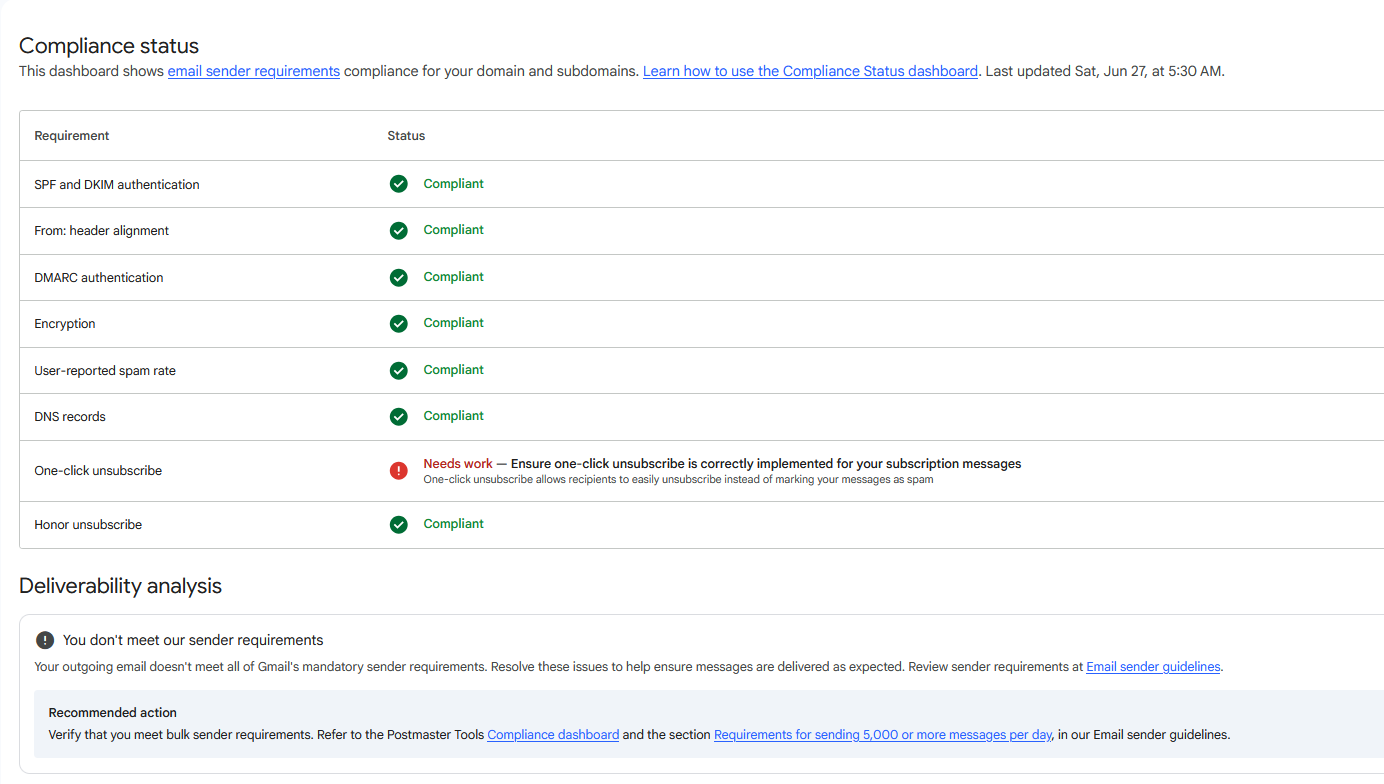
One-click unsubscribe flagged “Needs work” while every other requirement stays Compliant.
Honor unsubscribe
A separate check from one-click unsubscribe itself – this one verifies that unsubscribe requests, once received, are actually acted on.
| Spec reason | Google’s Definition |
|---|---|
| NOT_HONORING | The sender does not honor unsubscribe requests. |
| NOT_HONORING_TOO_FEW_CAMPAIGNS | The sender does not honor unsubscribe requests and consider to increase the number of relevant campaigns. |
| NOT_HONORING_TOO_MANY_CAMPAIGNS | The sender does not honor unsubscribe requests and consider to reduce the number of relevant campaigns. |
From: header alignment
Flagged when the domain in the From: header doesn’t align with either the SPF or DKIM domain. Common cause: a marketing platform sending “on behalf of” your domain in a way that breaks DMARC alignment, even though SPF and DKIM individually still pass.
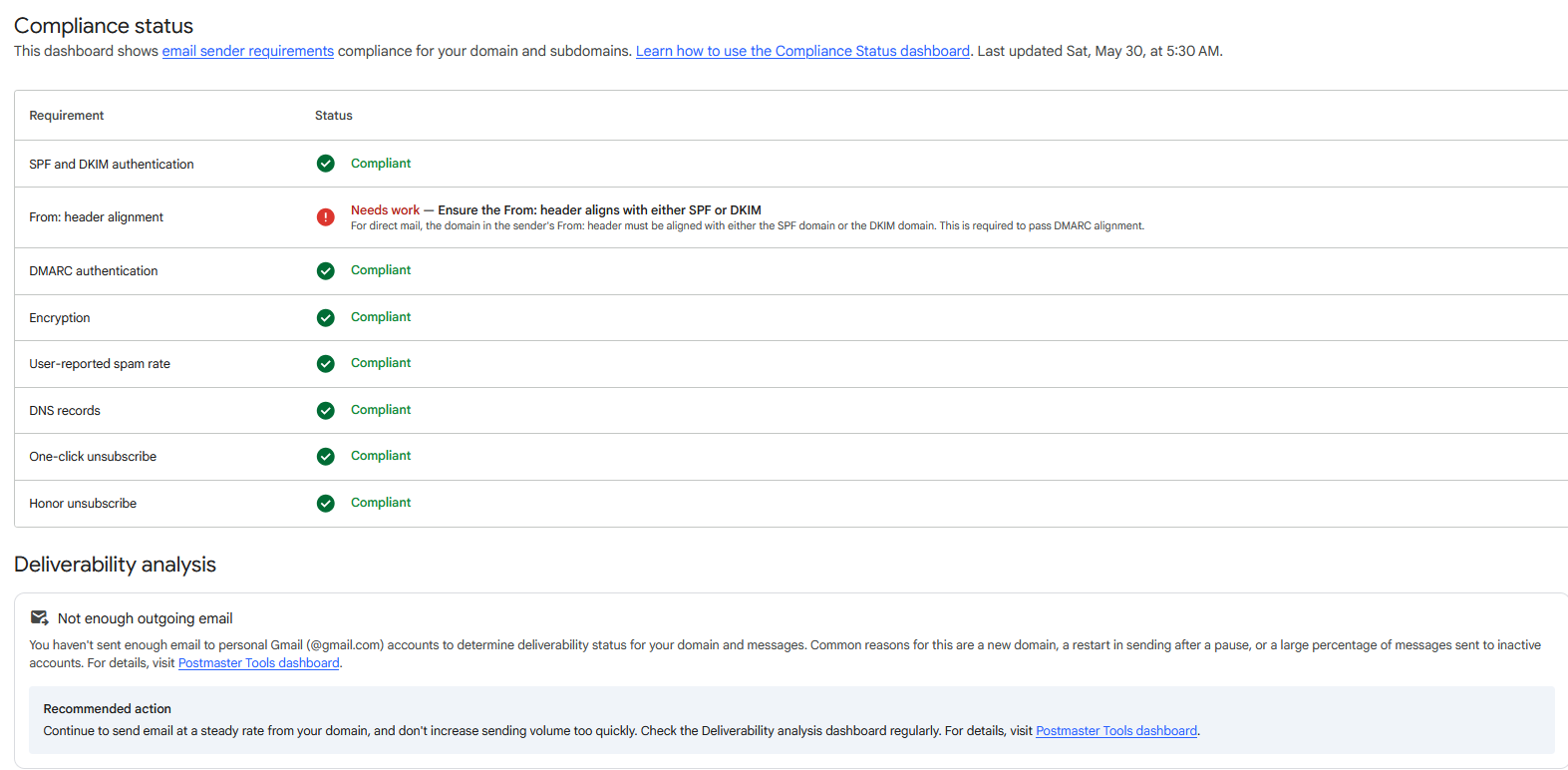
From: header alignment flagged “Needs work” – SPF and DKIM still pass individually, but they don’t align.
DMARC authentication
Worth showing alongside the alignment failure above, since the two are easy to conflate: DMARC authentication (the policy itself being published) and DMARC alignment (the From: header matching SPF or DKIM) are tracked as separate pass/fail conditions.
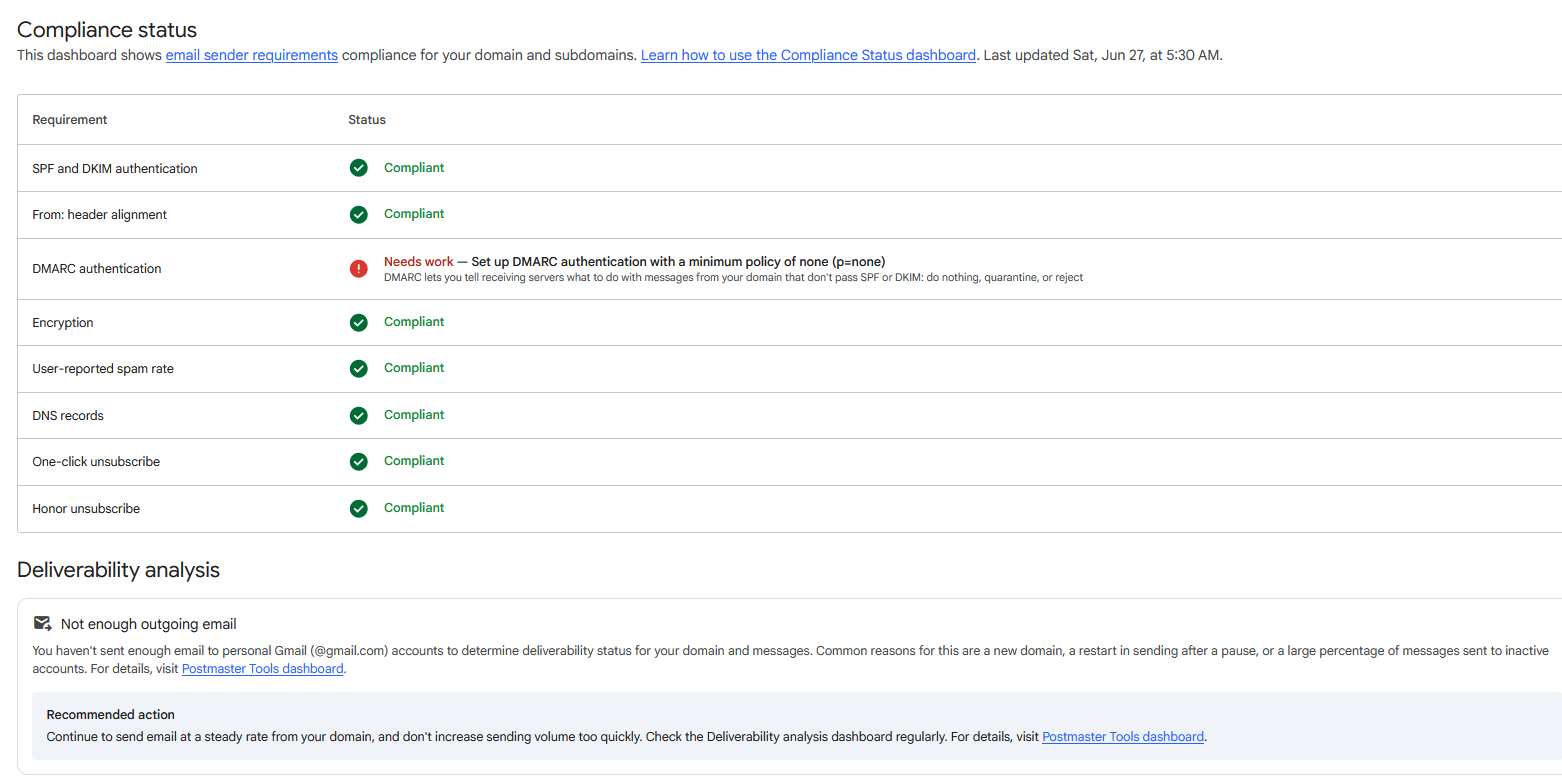
DMARC authentication flagged “Needs work” – a separate check from DMARC alignment, even though both fall under “DMARC” in conversation.
🗣️ Google Postmaster Tools Verdicts: Seven Documented Reasons
Source: Google’s Postmaster Tools API reference, DeliverabilityStatusVerdict Reason enum (domains.getComplianceStatus, v2, Developer Preview) – view on developers.google.com.
“Users signal they want to get your email messages”
Inbox placement is solid and complaint rate is low, or recipients are actively rescuing misclassified mail from spam. Action: keep doing what you’re doing – don’t change volume or list composition abruptly just because things look good.
Spec reason: USER_FEEDBACK_POSITIVE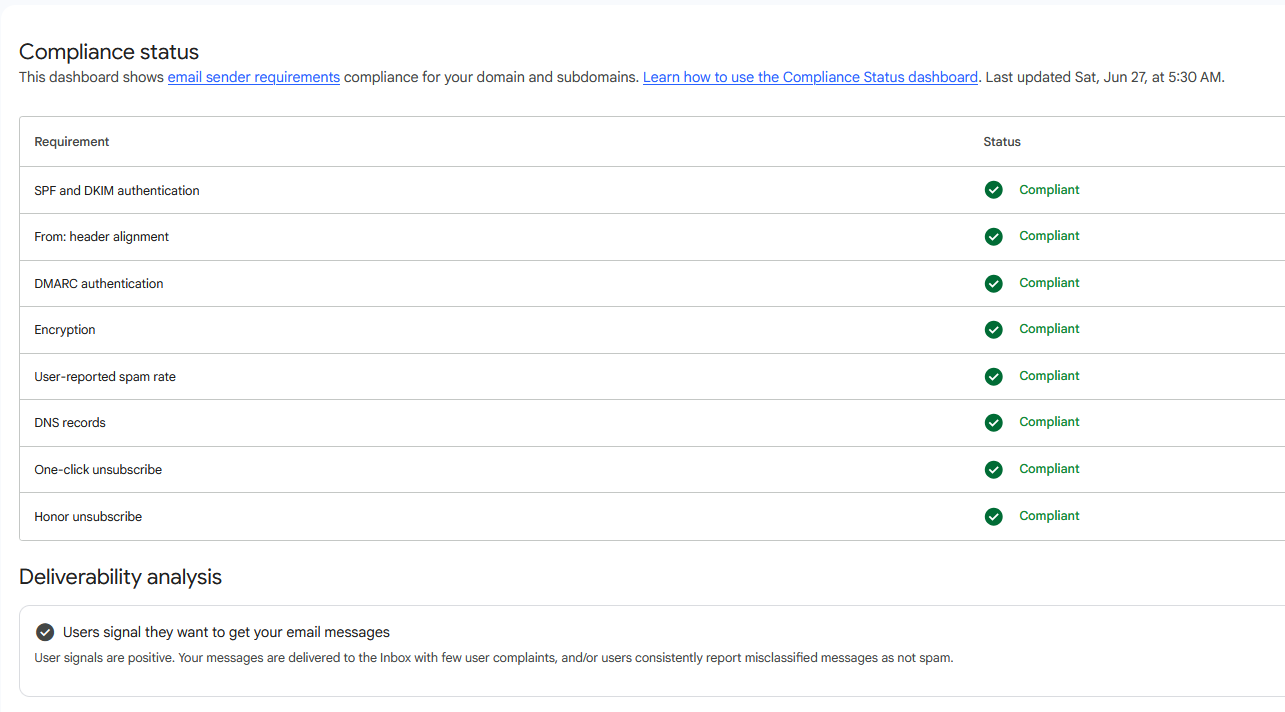
A fully compliant domain paired with the positive deliverability verdict.
“Users signal they don’t want to get your email messages”
Recipients are frequently reporting inbox-delivered mail as spam, and/or not rescuing spam-folder mail as legitimate. Action: this is the one that needs an actual remediation plan – review who you’re sending to, how often, and whether the content matches what they signed up for.
Spec reason: USER_FEEDBACK_NEGATIVE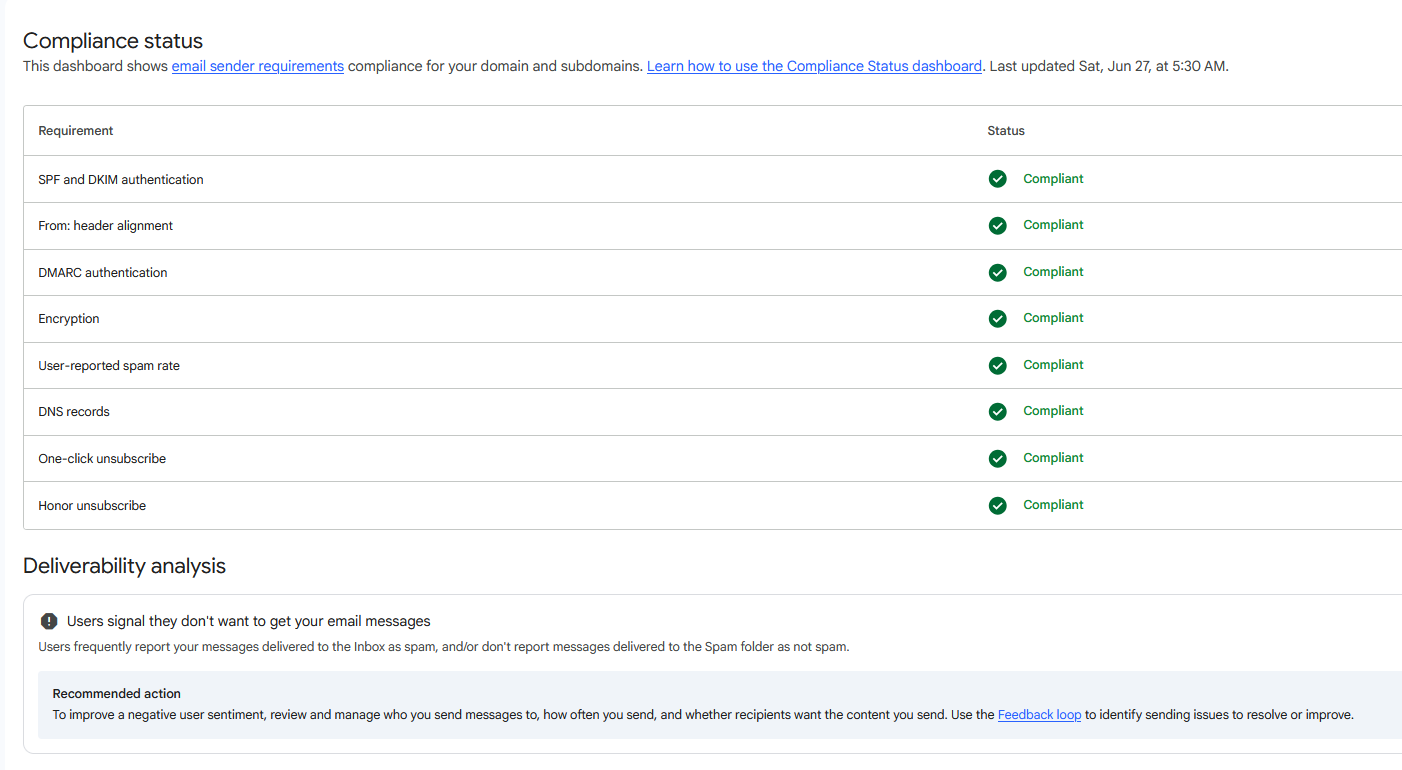
Full compliance, every checkbox green – and still a negative deliverability verdict. This is the pairing worth paying attention to.
“Users don’t take action on your messages”
Minimal signal either way – low opens, low complaints, low engagement of any kind. Action: not urgent, but worth investigating list quality and relevance before it drifts toward the negative verdict.
Spec reason: USER_FEEDBACK_LOW
Fully compliant, but recipients aren’t engaging either way – Gmail flags this as a flat, no-signal verdict.
“Not enough outgoing email”
Too little volume sent to personal Gmail addresses to compute a verdict at all – typical for new domains, a restart after a pause, or a list weighted toward inactive accounts. Action: keep sending at a steady, gradual pace. Don’t try to “catch up” with a volume spike; that’s how you trigger reputation problems instead of fixing the data gap.
Spec reason: MESSAGE_VOLUME_LOW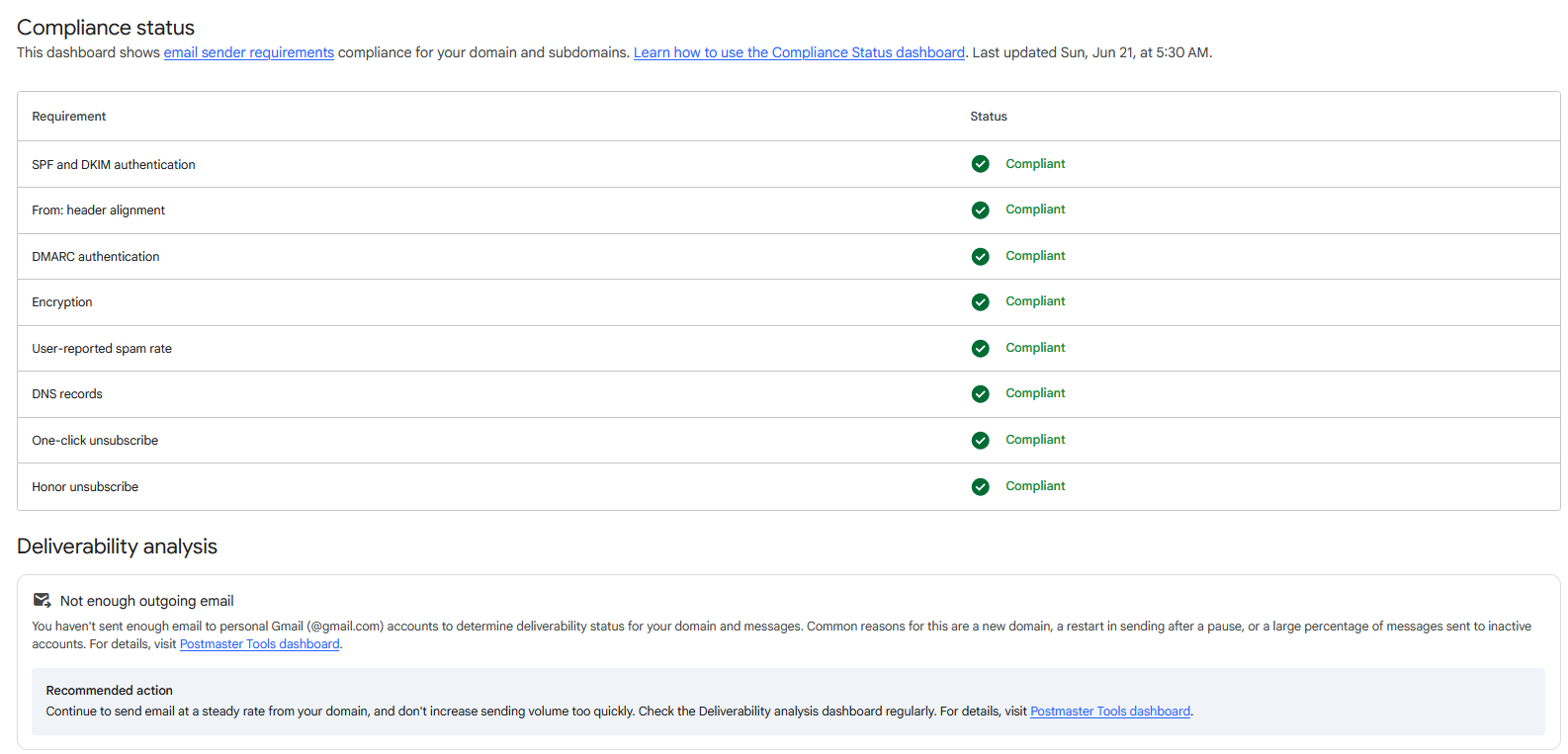
“Not enough outgoing email” – a data gap, not a reputation problem.
“You don’t meet our sender requirements”
This is Deliverability Analysis reflecting a Compliance Status failure straight back at you. The two dashboards aren’t actually independent – fail any one checklist item and it surfaces here too, as its own deliverability verdict, not just a row in a table.
Spec reason: SENDER_NOT_COMPLIANT“Your spam rate is high”
Triggers when reported spam complaints cross a fixed threshold. Action: pull back volume and frequency immediately, and audit what changed – a content shift, a list import, or a re-engagement send to a dormant segment are the usual causes.
“Many messages have delivery errors”
Triggers on a high rate of SMTP-level delivery failures, typically following a volume spike or an infrastructure problem on the sending side. Action: check for recent ramp changes, IP or MTA issues, and be aware Gmail may already be delaying affected mail rather than rejecting it outright – this verdict can show up alongside a separate delivery-delay warning.
Spec reason: SMTP_ERRORS_HIGH⚠️ Where It Gets Interesting: Compliance and Deliverability Disagree The most useful thing the new wording does is separate two questions that used to get blurred together.
On one domain we checked, every single Compliance Status item was green – full marks, nothing flagged – and the Deliverability Analysis verdict was still “Users signal they don’t want to get your email messages.”
That’s not a contradiction. SPF, DKIM, and DMARC passing tells Gmail you are who you claim to be. It says nothing about whether the people receiving your mail actually want it. Those are two separate problems, and for a long time Postmaster Tools made you infer that distinction yourself from a handful of charts. Google Postmaster Tools verdicts just say it outright now.
We also saw the inverse pairing on other domains: full compliance plus a positive “want your messages” verdict, and full compliance sitting in the flat, no-signal “don’t take action” zone. Same technical setup in all three cases – what changed was recipient behavior, not configuration. That’s precisely the gap a deliverability audit is built to catch, because a client looking only at green checkmarks would have no reason to suspect anything was wrong.
There’s a practical reason this matters beyond the dashboard itself. A chart can be argued with – plenty of clients have looked at a spam-rate graph and decided it’s fine, actually, or that the consultant is overstating the risk. A sentence rendered directly inside Google’s own interface is harder to wave off. “Users signal they don’t want to get your email messages,” in Gmail’s own words, tends to end that particular argument the first time a client sees it.
🎯 Key Takeaways
- Google Postmaster Tools verdicts are quietly layering plain-English sentences onto Compliance Status and Deliverability Analysis – undocumented by Google publicly, but specified in its own Postmaster Tools API reference
- Seven verdicts exist in the spec: positive, negative, low-engagement, low-volume, non-compliant, high spam rate, and high delivery errors.
- The spam-rate verdict fires at 0.1% complaints, not the 0.3% ceiling most sender guidance has trained people to watch – a domain can look “fine” by the public number and still trigger this verdict
- Compliance Status grades configuration; Deliverability Analysis grades recipient sentiment – passing one says nothing about the other, and a domain can be fully compliant with a negative deliverability verdict
Google Postmaster Tools verdicts are useful precisely because they force the two questions apart instead of letting “the charts look fine” stand in for “recipients want this mail.” If you’re managing more than a couple of domains, it’s worth checking both dashboards on each one rather than assuming a clean compliance table means the deliverability story is also clean.
👉 Not sure what your own Postmaster verdicts are telling you – or what to actually fix?
Book a Free Deliverability ConsultationVerdict wording and screenshots for the four confirmed verdicts reflect Google Postmaster Tools as directly observed across managed domains in late June 2026. The eleven-condition compliance breakdown, the seven deliverability verdict reasons, and the 0.1% spam-rate threshold are all drawn directly from Google’s own Postmaster Tools API reference (domains.getComplianceStatus, Developer Preview). Rollout, exact phrasing, and which accounts see the plain-language layer may vary; confirm against your own dashboard before publishing client-facing guidance based on this post.